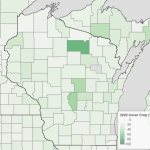
The Carbon Reduction Potential Evaluation Tool (CaRPE) is designed to explore historical and projected greenhouse gas mitigation potentials on agricultural lands resulting from the adoption of conservation practices.
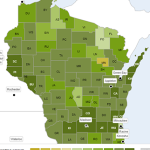
This website presents rankings by County across the U.S. of various health related topics in two categories: health factors, and health outcomes.
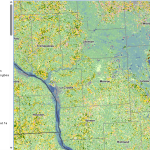
The CropScape portal interfaces with the USDA National Agricultural Statistics Service (NASS) Cropland Data Layer (CDL). CropScape uses remote sensing, ground truthing, and special algorithms to provide a comprehensive 30 x 30 meter census of land cover.
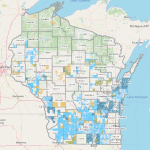
This list of web map applications from the WI Department of Agriculture, Trade, and Consumer Protection provides access to data on agricultural land-use designations and regulatory boundaries, allowing for highly localized technical assistance.
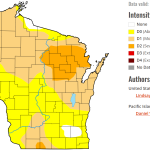
The U.S. Drought Monitor is a weekly snapshot of drought conditions, visualizing the severity of drought and where it is occurring.
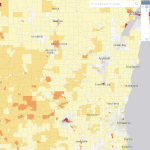
EJScreen, the EPA’s Environmental Justice Screening and Mapping Tool is designed to highlight places that may have more exposure to health-impacting environmental risks and under-resourced or more vulnerable populations.
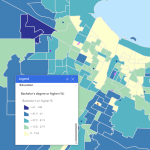
The EPD maps five categories of socioeconomic and demographic Census data at the County, County Subdivision, Tract, and Block Group levels, and includes a number of community assets for additional local context.
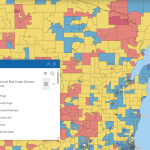
The Resilience Analysis and Planning Tool (RAPT) allows users to combine layers of community resilience indicators, infrastructure locations and hazard data. Users can visualize community resilience challenges to inform decisions around preparedness, mitigation, response and recovery.
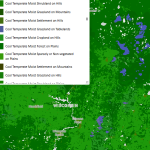
This resource, access to which is limited to account holders (sign up is free), brings together geospatial data coordinated by several Federal Agencies. Topics include ecosystems, geology, soils, climate, cultural resources, transportation, and many others.
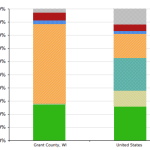
Headwaters Economics is a nonprofit research group focusing on community development and land management. Offered here are a number of tools designed to assess various types of risk at the county or community level.
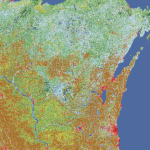
The Multi-Resolution Land Characteristics consortium provides users with high-resolution, longitudinal data on land cover, enabling them to track how landscapes have transformed over several decades.
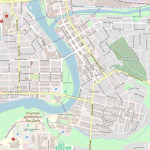
OpenStreetMap is a free and open geographic database of the built environment maintained and updated by a community of professionals and enthusiasts.
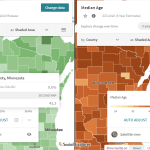
The Social Explorer, available with a UW NetID login, allows the user to access and map an extensive list of demographic, socio-economic, health, environmental, business, and election data sets.

USDA farmers.gov county dashboards pull together current data on commodity prices, weather, and USDA Programs.
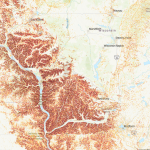
The USGS Landslide Inventory provides a comprehensive spatial database of documented landslides, including their locations, types, and movement characteristics.
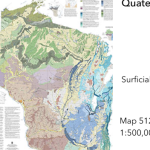
This resource from the Wisconsin Geologic and Natural History Survey conveniently gathers a large number of maps and spatial resources in one place. Click on the map to find resources by geographic area or browse by topic.