Moths emerge at end of month
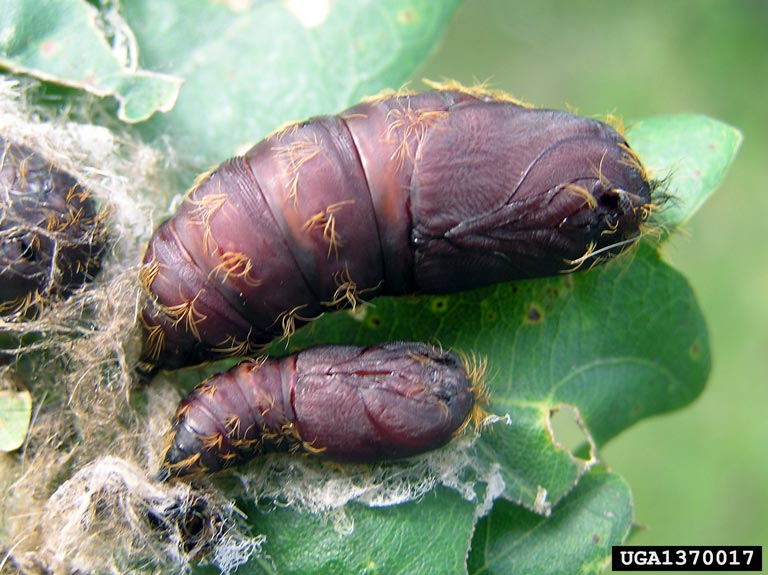
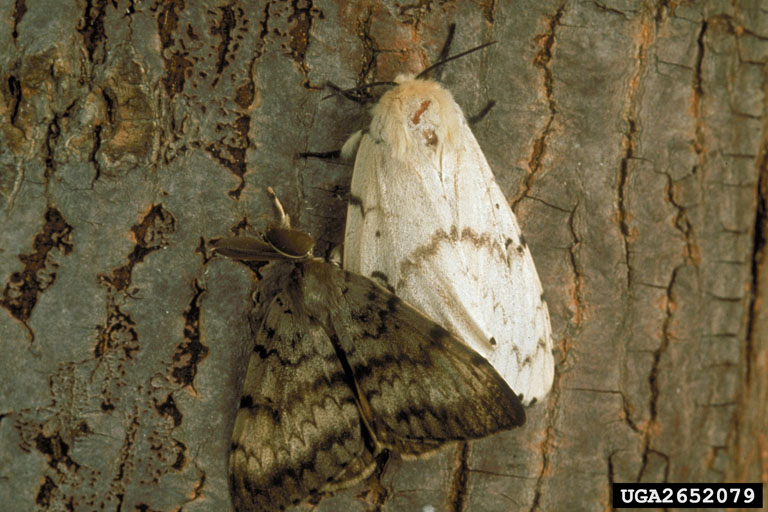
Spongy moth (Lymantria dispar) caterpillars finish feeding in July. The insects will then pupate and emerge as adult moths, in mid-late July or early August. Male moths resemble many other brown moths but actively fly in the afternoon looking for females—most other moths fly after dark. Female spongy moths are white, 1 1/2 inches long, and although they have wings they do not fly. They are usually found laying an egg mass as in the photo below. Both the pupa cases and moths can be crushed easily if you can find them.
Note: Adult female spongy moths possess a long-lasting chemical pheromone that strongly attracts male moths. Getting this pheromone on your skin, clothing, or objects such as gardening tools can make contaminated surfaces attractive to male moths. Using a disposable item (stick, etc.) or washable object to crush adult females can be helpful in this regard.
Mating disruption is a management technique used to decrease reproduction of spongy moths by preventing male moths from finding females. This technique works by applying the chemical pheromone (attractant) of the female to an area to mask the natural pheromone levels. As a result, male moths can be overwhelmed by the scent and have a harder time locating a female to mate with. The chemical pheromone used for mating disruption is highly specific to spongy moths, and is not harmful to humans or other animals. There is one pheromone-based product currently registered in Wisconsin for mating disruption—SPLAT GM-O (ISCA Technologies). This product is applied approximately two weeks before the emergence of adult moths.
A limitation of this technique is that it is suitable only for low populations of the spongy moth over relatively large areas. Mating disruption is used by the Wisconsin Department of Agriculture, Trade and Consumer Protection (DATCP) to combat spongy moth over larger areas as part of its “Slow the Spread” program, but it is not an effective technique for individual homeowners.